男儿本色
China turns tennis tournaments into tourism magnet as cities package matches with culture, food and city experiences_我的网站

A | (ECNS) -- The Beijing Economic-Technological Development Area, also known as Beijing E-Town, has emerged as a major destination for AI investment, with several companies securing funding worth billions of yuan this year. In the first half of the year, eight leading AI companies based in Beijing E-Town raised more than 15 billion yuan ($2.1 billion), spanning fields including world models, AI chips and AI-generated content, the official data released by the E-Town shows. AI video and world-model developer AIsphere recently completed its Series C funding round, raising a total of 2.98 billion yuan ($414 million). The funding will support the development of its video-generation foundation models, real-time world models and industrial applications, according to news released by the E-Town. Automotive chipmaker SemiDrive Technology completed a Series C funding round worth nearly $100 million in May. World-model company VAST secured more than 1 billion yuan ($139 million) in strategic investment in July, bringing the total raised in its Series A funding rounds to nearly 3 billion yuan ($417 million). During the 14th Five-Year Plan period (2021–2025), Beijing E-Town established government-guided funds totaling about 20 billion yuan ($2.8 billion). It has also recently launched four new industrial investment funds with a combined value of 20 billion yuan, including an 8-billion-yuan fund focused on AI and integrated circuits. Beijing E-Town said during the 15th Five-Year Plan period (2026–2030) it will continue to expand support for AI development across the entire industry chain, from computing infrastructure and algorithms to models and applications. (By Helen Mo, intern Liu Shuangjing) 
 。
。
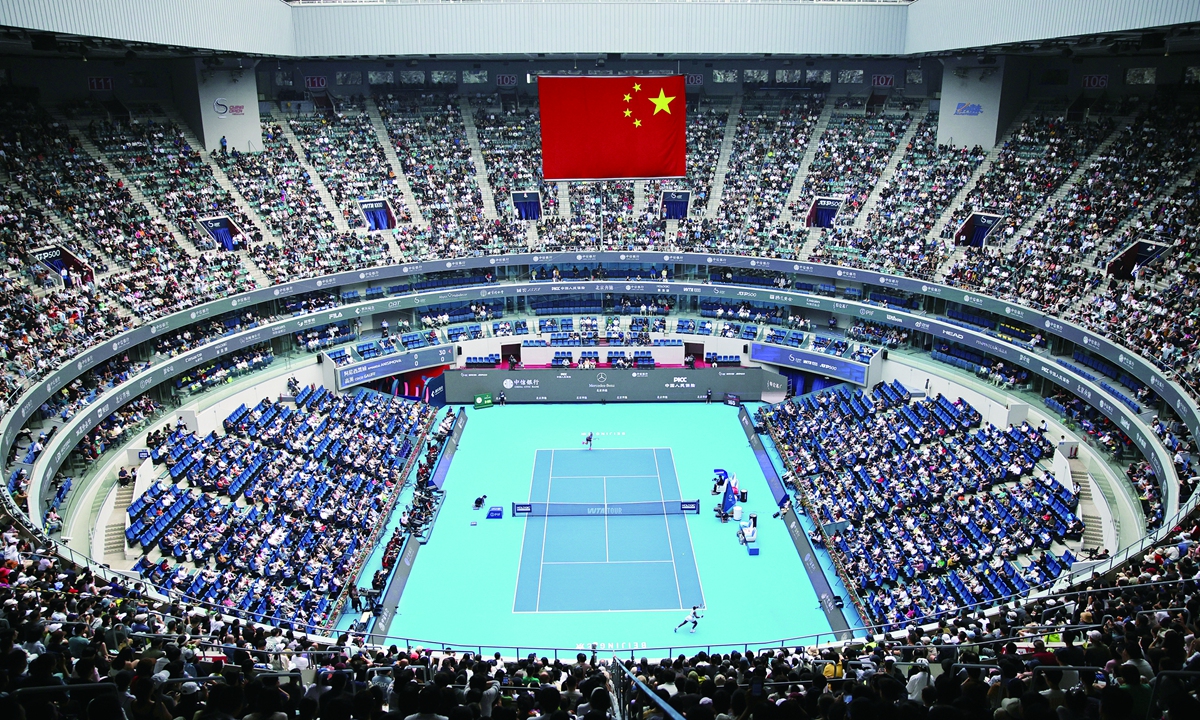
As international tennis tournaments multiply across China this autumn, organizers are increasingly looking beyond the court, seeking to turn a trip to a tournament into a broader travel experience.
The 2026 Chinese tennis season, starting in September, will bring a series of international events to cities including Chengdu, Hangzhou and Suzhou besides flagship events in Beijing and Shanghai.
The growing concentration of tournaments is giving Chinese cities a chance to connect sporting events with local consumption, cultural activities and tourism.
Shanghai offers perhaps the clearest example of how that strategy is developing.
In 2025, the Shanghai Masters attracted more than 250,000 spectators, with about 10 percent coming from overseas and 60 percent from outside Shanghai, according to the Shanghai municipal government. The tournament also generated more than 100 million yuan ($14.8 million) in ticket revenue.
The figures have encouraged organizers and city authorities to think beyond the traditional model of selling a ticket to a tennis match.
During this year's Shanghai Masters, ticket packages will include options combining matches with direct transportation, family experiences and visits to other Shanghai attractions, the organizers have announced.
The approach fits into Shanghai's broader effort to use major sporting events to attract international visitors.
The experience in Shanghai suggests that the relationship between tennis and tourism can work in both directions: a tournament brings people to a city, while the city gives spectators reasons to stay longer and spend money beyond the stadium.
For host cities, making tennis more than a sporting event can also serve as a platform for destination marketing, particularly when the event attracts an international audience.
Sports tourism can offer cities something that conventional sightseeing does not, according to tennis commentator Chen Chi.
"Tennis events can activate destinations and build recognizable identities," Chen told the Global Times. "The international player base and global fan following of tennis give host cities an audience well beyond their local audiences, which is widely seen at the Grand Slam events."
The challenge now is to make those visitors stay longer and explore more of the host city. That is where the "ticket plus" model comes in.
Rather than simply asking visitors to buy a match ticket, organizers are increasingly packaging the tournament with hotels, transportation, attractions and other experiences.

Culture matters
In Suzhou, East China's Jiangsu Province, organizers of the WTA 125 Suzhou Open are trying to connect the tournament with the city's existing cultural resources.
Zhou Yunsong, tournament director of the Suzhou Open, said the timing gives spectators an opportunity to combine a tennis trip with a holiday as it partially overlaps with the annual National Day holidays.
"For our spectators, this is a rare opportunity to combine watching tennis with travel. For domestic tennis fans, they don't have to take time off work as they normally would," Zhou told the Global Times.
The tournament venue, the Yangcheng Lake International Tennis Center, is located near several cultural and commercial areas in Suzhou.
The event has also introduced a hotel-and-tennis package, while organizers have arranged cultural experiences for players, including visits to Suzhou's gardens and local cultural venues.
"To give players an immersive experience of Suzhou's charm, we have planned a range of cultural activities, including visits to the Suzhou Museum, tasting authentic Suzhou cuisine, listening to Kunqu Opera, trying on traditional Chinese qipao and visiting embroidery workshops," Zhou noted.
Zhou sees a broader change in the way people plan trips.
"Traveling to sporting events is becoming a choice for more and more people," he said. "In the past, tourism was about sightseeing - going to a destination, taking photos and checking in. Now, especially among younger generations, people are more inclined to take themed trips."
The idea, he said, is to use the tournament as the starting point for a much wider city experience.
"We hope Suzhou can, with the professional tournament at its core, connect all of Suzhou's tourism resources, including its food, gardens, water towns and shopping, so that visitors can travel around the city for the sake of one match."
Players as ambassadors
For international tennis, this model has another potential advantage: The players themselves can become part of a city's tourism promotion.
Beijing, for instance, is bringing the players themselves into the tourism story. Li Xuhua, general manager of the China Open, said the tournament plans to give players more opportunities to experience the city.
Current world No.1 Jannik Sinner is among the players who are invited to participate in a hutong (traditional alleyway) tour during his stay in Beijing, Li told the Global Times.
The China Open is also expanding its off-site activities this year.
Li said the tournament will work with the local government to establish more match-watching venues in major commercial areas, allowing people to experience the tournament outside the main tennis center.
"The information from the tennis court can go out and reach people around the city," Li said.
For organizers such as Li, the goal is to make the tournament a broader part of the city's cultural and public life.
"We want this rare tennis carnival to be richer and more colorful, and to give fans more time to experience the appeal of tennis," Li said.
The emerging model is still at an early stage as different event organizers are exploring their own strategies. But the direction is becoming clearer: Tournaments are being used not only to fill seats in stadiums, but also to promote cities as travel destinations.
。
Current article:http://d6xn.gamajionghuanmuniuzhuanguchu.cyou/q57/fxs2uoi.html
Published on:22:48:28
淄博新闻


- ·成都全面取消限购 住房交易不再审核购房资格
- ·【一线经济观察】河北:深耕文化底蕴 创意赋能文旅高质量发展
- ·6.3 magnitude earthquake hits Afghanistan days after devastating weekend quakes
- ·偷税超300万被罚后,知名网红女主播“复活”:制售高仿大牌服装,近百个号带货超百万元!
- ·3 dead after partial residential building collapse in north China’s Shijiazhuang
- ·首次以总理身份出席国庆庆典 黄循财平价球鞋爆红
- ·抖音起家转战淘宝直播 罗永浩俞敏洪开启跨平台带货


